

Divorce Lawyer in Delhi High Court
If you are looking for a Divorce Lawyer in Delhi High Court, it is important to understand that matrimonial proceedings at the High Court level can involve complex questions of law, appellate procedure, jurisdiction, constitutional remedies, interim relief, and challenges to orders passed by lower courts. A matter may reach the Delhi High Court after a Family Court has passed an order or judgment, or it may require High Court intervention because of a particular legal or procedural issue. Depending on the circumstances, matrimonial litigation can involve appeals against family court judgments, transfer petitions, writ petitions, custody appeals, alimony or maintenance disputes, and proceedings seeking appropriate relief against criminal proceedings arising from matrimonial disputes.
At Top Divorce Lawyer, we provide legal assistance in matters involving divorce and matrimonial proceedings before the Delhi High Court, with an approach focused on understanding the facts, examining the impugned order or proceeding, identifying the legally appropriate remedy, and preparing the necessary pleadings and supporting documents. A Delhi High Court Divorce Lawyer may assist with reviewing the Family Court record, identifying possible grounds of challenge, preparing an appeal or petition, addressing limitation and maintainability issues, and presenting legal submissions during hearings. High Court proceedings also require careful compliance with applicable filing requirements and procedural rules. The Delhi High Court itself identifies requirements concerning matters such as certified copies, affidavits, correct legal provisions, filing formalities, and other procedural documents. Every matrimonial case is different, and the availability of a particular remedy depends on the facts, applicable law, procedural stage, and nature of the order being challenged. Our objective is to provide clear, professional, and case-specific legal assistance to clients dealing with Delhi High Court Matrimonial Cases, while helping them understand the available legal routes and the procedural steps involved.


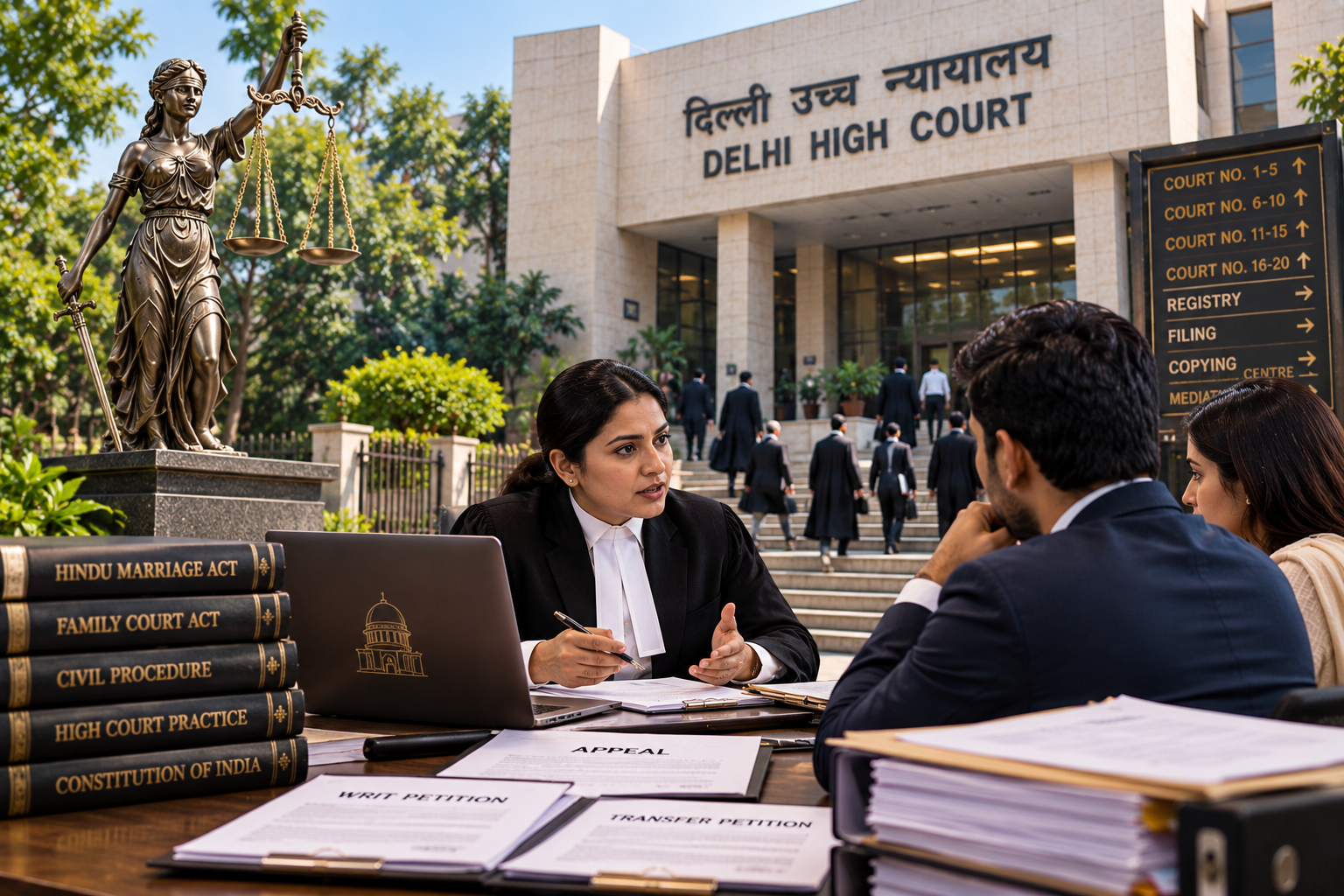
Delhi High Court Matrimonial Cases
Delhi High Court Matrimonial Cases can involve a wide range of legal proceedings arising from marriage, divorce, family disputes, and orders passed by subordinate courts. Unlike a routine divorce proceeding before a Family Court, a High Court matter may involve an appeal, petition, transfer application, writ proceeding, challenge to an interim order, custody-related appeal, maintenance or alimony dispute, or another legal remedy depending on the circumstances. For this reason, selecting a lawyer familiar with both matrimonial law and High Court procedure can be important. A Divorce Lawyer in Delhi High Court can begin by examining the relevant documents, including the Family Court judgment or order, pleadings filed by the parties, evidence available on record, previous interim orders, and any other material necessary to understand the procedural history. The lawyer can then assess the nature of the legal grievance and determine whether an appeal, petition, transfer proceeding, writ remedy, or another appropriate course should be considered. High Court litigation also requires attention to procedural requirements. The Delhi High Court publishes filing requirements and common objections relating to matters such as certified copies, affidavits, proper stamping, memoranda, limitation, and identification of the correct legal provision. Proper drafting is therefore an important part of matrimonial litigation at this level. A petition or appeal should clearly explain the relevant facts, legal grounds, relief sought, and supporting material without relying on unnecessary allegations.
Why Choose TopDivorceLawyer
- Experienced Lawyers: Skilled in handling mutual divorce cases with expertise under the Hindu Marriage Act.
- Quick and Efficient Process: We ensure a hassle-free, fast divorce process to save your time and energy.
- Confidentiality Assured: Your privacy is our priority; all your personal and legal details remain secure with us.
- Affordable and Transparent Fees: Clear, affordable pricing with no hidden costs—quality legal services within your budget.
- Personalized Legal Solutions: Tailored advice and solutions suited to your specific needs for a smooth divorce experience.
- End-to-End Assistance: From petition filing to final decree, we assist you through every step with care.
Divorce Cases in Delhi High Court
Divorce Cases in Delhi High Court can arise in different procedural situations, particularly when a party seeks to challenge an order or judgment passed by a Family Court or requires High Court intervention in a matrimonial dispute. A High Court matter is not necessarily a fresh divorce trial in the same form as proceedings before the Family Court. Depending on the legal basis of the proceeding, the High Court may be dealing with an appeal, petition, transfer request, constitutional remedy, or another form of jurisdiction. A Divorce Lawyer in Delhi High Court can examine the nature of the order being challenged and determine the legally appropriate course of action. For example, an appeal may involve alleged errors in appreciation of evidence, application of law, procedural irregularities, or other recognised grounds. The precise remedy depends on the statute governing the proceeding and the nature of the order. The Delhi High Court has published procedural requirements concerning appeals and filings, including certified copies and other documents that may be required for proper presentation of a matter.
A lawyer may also need to examine whether the proceeding is within the prescribed limitation period and whether the proposed remedy is legally maintainable. Matrimonial disputes can also involve connected issues such as custody, maintenance, alimony, or allegations arising from the matrimonial relationship. These issues may require separate legal analysis depending on the orders involved. At Top Divorce Lawyer, our approach is to first understand the procedural history and identify exactly what relief the client seeks from the Delhi High Court. We then consider the relevant documents, evidence, applicable law, and procedural requirements before preparing the case. High Court litigation requires precision because an appeal or petition should be supported by legally sustainable grounds rather than simply repeating the arguments made before the lower court. Our objective is to provide professional legal assistance throughout the relevant stages of Divorce Cases in Delhi High Court, while ensuring that clients understand that the final decision rests with the competent court.
Appeals Against Family Court Judgments
Appeals Against Family Court Judgments are an important part of the matrimonial litigation handled before the Delhi High Court. A person who believes that a Family Court judgment or order contains a material legal or procedural error may have a statutory right to challenge it, subject to the applicable law, maintainability requirements, limitation, and nature of the order. A Divorce Lawyer in Delhi High Court can review the judgment and underlying record to determine whether there are legally recognised grounds for an appeal. The review may include examination of how evidence was appreciated, whether relevant evidence was ignored, whether the applicable legal provisions were correctly interpreted, whether procedural requirements were followed, and whether the relief granted or refused was legally sustainable. An appeal is not simply an opportunity to repeat every argument made before the Family Court. The grounds should identify specific errors that justify appellate intervention. The Delhi High Court's published filing guidance demonstrates the importance of procedural compliance, including requirements concerning certified copies, affidavits, limitation, memoranda, and other filing documents. Depending on the matter, the appellate court may examine the record and arguments presented by the parties within the scope permitted by the applicable law. A lawyer may therefore assist with preparing the memorandum of appeal, identifying the challenged findings, organising supporting documents, formulating grounds, and presenting oral submissions. Interim relief may also be considered where the circumstances justify such a request. At Top Divorce Lawyer, we approach Appeals Against Family Court Judgments by first examining the complete judgment and relevant record rather than relying only on the client's summary of the dispute. This helps identify the actual findings that need to be challenged and the legal basis for seeking modification, setting aside, or other appropriate relief. Every appeal is fact-specific, and filing an appeal does not automatically mean that the lower court's decision will be reversed. The outcome depends on the applicable law, record, and determination of the Delhi High Court.
Writ Petitions in Matrimonial Disputes
Writ Petitions in Matrimonial Disputes may arise where a party seeks constitutional or public-law relief from the High Court in circumstances falling within the court's writ jurisdiction. Such proceedings are distinct from an ordinary divorce petition and should not be treated as a substitute for every matrimonial remedy. A Divorce Lawyer in Delhi High Court can assess whether the facts and nature of the grievance justify considering a writ petition or whether another legal remedy is more appropriate. Depending on the circumstances, writ proceedings may involve allegations concerning unlawful action by a public authority, violation of legal or constitutional rights, jurisdictional issues, or circumstances requiring urgent judicial intervention. In matrimonial disputes, the precise relief available depends heavily on the facts and legal basis of the petition. For example, certain custody-related situations may involve constitutional remedies, but the court's jurisdiction and the appropriate remedy must be assessed carefully rather than assumed. A writ petition generally requires precise drafting because the petitioner must establish the legal basis for invoking the High Court's jurisdiction and explain why the requested relief is appropriate. The petition should be supported by relevant documents and a clear statement of facts. A Delhi High Court Divorce Lawyer may assist with reviewing the circumstances, identifying the appropriate legal provisions, preparing the petition, compiling supporting documents, and presenting arguments during hearings. Where urgent relief is sought, the factual circumstances supporting urgency should be clearly placed before the court. It is also important to consider whether an alternative statutory remedy exists and how that may affect the maintainability of a writ proceeding. At Top Divorce Lawyer, we approach Writ Petitions in Matrimonial Disputes on a case-specific basis and do not recommend a writ merely because a matrimonial dispute is difficult or urgent. The appropriate legal route depends on the nature of the grievance, the authority involved, available statutory remedies, and applicable constitutional principles. Professional legal assessment can therefore help determine whether High Court writ jurisdiction is appropriate for the particular matrimonial matter.
Transfer Petitions in Matrimonial Cases
Transfer Petitions in Matrimonial Cases may become relevant when a party seeks to move a matrimonial proceeding from one court or jurisdiction to another because of circumstances recognised under the applicable law. Matrimonial litigation can sometimes involve substantial travel, personal hardship, safety concerns, conflicting proceedings, or other circumstances that may form part of a transfer request. A Divorce Lawyer in Delhi High Court can review the facts and determine whether there is a legally sustainable basis for seeking transfer. A transfer petition should not be based merely on inconvenience unless the applicable legal framework and circumstances support the requested relief. The petition generally needs to explain the relevant proceedings, present the reasons for seeking transfer, identify the courts involved, and provide supporting material where necessary. The lawyer may also need to address the position of the opposing party and any connected proceedings pending elsewhere. In some cases, the other party may oppose the transfer and present reasons for retaining the matter in the existing court. Effective legal representation therefore requires careful presentation of both factual circumstances and the legal basis for the request. A Divorce Advocate in Delhi High Court can assist with preparing the transfer petition, compiling relevant orders and case details, responding to objections, and presenting submissions before the court. The lawyer can also examine whether multiple matrimonial proceedings are pending and whether their locations create procedural or practical concerns that should be brought to the court's attention. At Top Divorce Lawyer, we focus on presenting transfer matters with accurate facts and appropriate documentation rather than relying on general claims of inconvenience. The objective is to help the court understand why the requested transfer is legally and practically justified. Every transfer petition is decided on its own facts and applicable law, and filing such a petition does not guarantee that the matter will be transferred. Clients should therefore receive a realistic assessment of the circumstances before initiating proceedings. Proper preparation can help ensure that the request is presented clearly and supported by the relevant case record.
Custody Appeals in Delhi High Court
Custody Appeals in Delhi High Court can arise when a parent seeks to challenge an order concerning child custody, visitation, access, guardianship, or another child-related issue decided by a lower court. Matters involving children require particularly careful legal handling because the welfare and interests of the child are central to judicial consideration. A Divorce Lawyer in Delhi High Court handling a custody appeal may need to review the impugned order, pleadings, evidence, previous custody arrangements, relevant communications, school or medical records where applicable, and other material considered by the lower court. The purpose of an appeal is not simply to express dissatisfaction with the existing arrangement but to establish a legally sustainable basis for appellate intervention. Depending on the applicable law and circumstances, the parent may challenge findings that were allegedly unsupported by the record, procedural errors, failure to consider relevant circumstances, or other grounds recognised by the applicable appellate framework. Interim arrangements may also become important where the existing order creates an immediate concern relating to access or the child's welfare. A Child Custody Lawyer in Delhi High Court can assist with preparing the appeal, reviewing the lower court record, identifying relevant grounds, preparing applications for interim relief where appropriate, and presenting legal submissions. It is important for parents to avoid placing children in the middle of litigation or using them as messengers between the parties. Legal proceedings should focus on presenting relevant facts and evidence through appropriate channels. At Top Divorce Lawyer, we approach custody appeals with sensitivity because these matters can have significant consequences for children and parents alike. We focus on the legal record, applicable law, and welfare considerations relevant to the proceeding. The result of a custody appeal depends on the individual circumstances and judicial assessment; no specific custody arrangement or outcome can be guaranteed. Professional legal guidance can nevertheless help parents understand the appellate process, identify relevant documents, and present their concerns in an appropriate legal manner before the Delhi High Court.
Alimony Appeals in Delhi High Court
Alimony Appeals in Delhi High Court may arise when a party seeks to challenge an order concerning maintenance, alimony, or another financial arrangement made by a lower court, subject to the applicable law and availability of the relevant appellate remedy. Financial disputes in matrimonial proceedings can involve income, earning capacity, assets, liabilities, financial needs, responsibilities toward children, and other circumstances relevant under the applicable legal framework. A Divorce Lawyer in Delhi High Court can review the challenged order and examine whether the lower court appropriately considered the relevant evidence and legal principles. The grounds for challenging a financial order depend on the applicable statute, nature of the order, procedural route, and facts of the individual case. A lawyer may review income documents, financial disclosures, tax records, bank records, employment information, liabilities, and other relevant material where necessary and legally appropriate. The purpose is to identify whether the record supports the grounds being raised in the appeal or other proceeding. Where an interim financial arrangement is creating immediate hardship, an appropriate application may also need to be considered, depending on the procedural circumstances. A Divorce Advocate in Delhi High Court can assist with drafting the appeal or application, organising financial evidence, responding to the other party's submissions, and presenting arguments before the court. Financial proceedings should be approached carefully because incomplete or inaccurate disclosure can complicate the litigation. Clients should therefore provide their lawyer with complete and truthful information concerning their financial circumstances. At Top Divorce Lawyer, we focus on understanding the financial background and reviewing the relevant order before advising on an appellate strategy. The amount of alimony or maintenance is not determined by a universal fixed formula applicable to every case; it depends on the applicable law, facts, evidence, and judicial determination. Accordingly, an appeal should be based on identifiable legal or factual grounds rather than an expectation that a different amount will automatically be granted. Proper legal assessment can help determine whether an Alimony Appeal in Delhi High Court or another remedy is appropriate in the individual matter.
Note :- Mutual Divorce Lawyer (9616-166-166) can guide spouses whose matrimonial matter has reached the Delhi High Court and who have mutually decided to resolve their marital dispute. A matter before the High Court may have a different procedural background from an ordinary divorce proceeding, particularly when previous litigation, an appeal, transfer matter, or another matrimonial proceeding is already pending. For this reason, the complete history of the case should be examined before deciding how the mutual understanding between the spouses should be presented. When both parties have genuinely agreed to separate, their settlement needs to be considered in the context of the proceedings already before the Court. The legal team can review previous orders, petitions, agreements, and connected cases to determine what issues may still require resolution. This becomes especially important when multiple proceedings between the spouses have been initiated in different forums. A properly prepared settlement can help present the parties' common position clearly and reduce uncertainty regarding unresolved matrimonial disputes. The appropriate legal remedy depends upon the facts and procedural stage of each individual matter. Couples should therefore obtain professional advice before relying on a privately prepared agreement or taking any step before the High Court. If you require assistance regarding Mutual Divorce in Delhi High Court, including examination of an existing matrimonial matter, settlement-related advice, petition preparation, or representation, you can contact Mutual Divorce Lawyer (9616-166-166) for legal consultation.