

Legal Consequences of Marriage Annulment
The Legal Consequences of Marriage Annulment depend on whether the marriage is treated as void or is annulled as a voidable marriage and on the applicable matrimonial statute. A decree of nullity addresses the legal status of the marriage, but it does not necessarily mean that every issue arising from the relationship disappears automatically. Courts may still have to consider matters involving children, maintenance, property and other rights where the applicable law provides for such relief. The Hindu Marriage Act contains a specific provision concerning the legitimacy of children of void and voidable marriages. Section 16 provides statutory protection to children of marriages that are null and void or annulled by a decree of nullity, subject to the provisions of that section. Consequently, an annulment should not be understood as removing the legal protections available to children.
Financial and family-related questions can also require separate consideration based on the relevant law and facts. The legal consequences can therefore be more nuanced than the simple statement that an annulled marriage “never existed.” In a voidable marriage, the court’s decree is particularly significant because the marriage is annulled through judicial intervention under the statutory framework. Property rights and financial claims can also depend on ownership, contribution, applicable legislation and the particular circumstances of the parties. Anyone pursuing Marriage Annulment should therefore obtain advice not only about obtaining the decree of nullity but also about the consequences that may follow from it. A complete legal strategy should consider the marriage status, children, financial claims, property issues and any other connected proceedings before the case is filed.


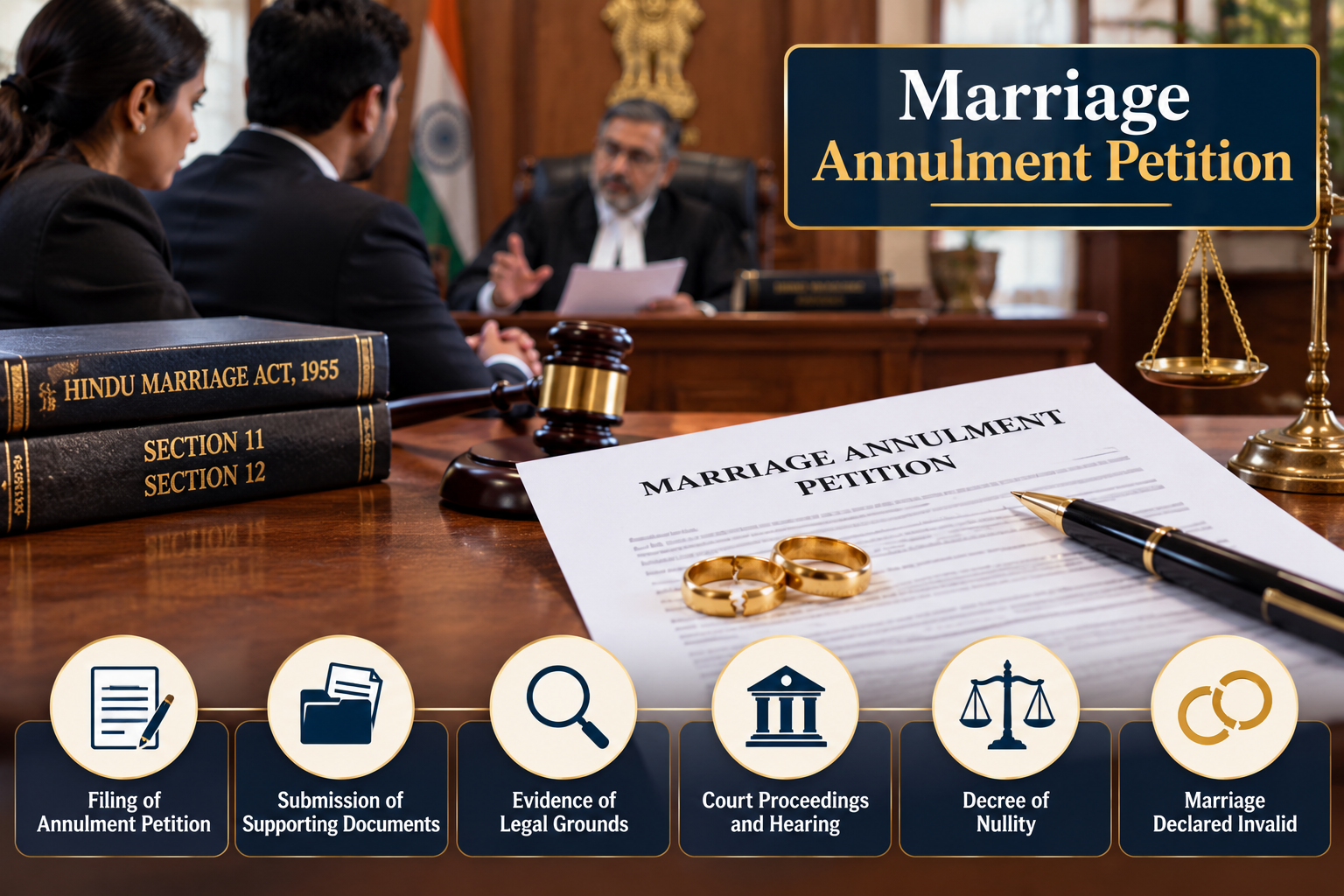
Marriage Annulment Petition
Eligibility for Maintenance Under Section 24 HMA depends primarily on whether the applicant has sufficient independent income to meet their own support requirements and the necessary expenses of the matrimonial proceeding. Section 24 expressly provides the remedy to either the wife or the husband, making it a gender-neutral provision. The applicant must demonstrate circumstances indicating that their independent income is insufficient for their support and the expenses associated with the proceeding. The existence of some income does not necessarily mean that a person is automatically disqualified. The relevant consideration is whether that income is sufficient in the circumstances of the case. Section 24 specifically directs the court to consider the petitioner's own income and the income of the respondent when determining what monthly amount may be reasonable. IndiaCode by eCourtsIndia This means that a court may need to examine the complete financial position of both parties rather than looking at only one salary figure. Employment status, professional earnings, business income, investments, property-related income, liabilities and regular financial responsibilities may become relevant depending on the facts. A spouse who is qualified but currently unemployed should not assume that eligibility is automatic, just as a spouse who is employed should not assume that having a salary necessarily prevents a Section 24 claim. The court assesses the actual financial circumstances and evidence presented before it. Financial disclosure is therefore critical.
Why Choose TopDivorceLawyer
- Experienced Lawyers: Skilled in handling mutual divorce cases with expertise under the Hindu Marriage Act.
- Quick and Efficient Process: We ensure a hassle-free, fast divorce process to save your time and energy.
- Confidentiality Assured: Your privacy is our priority; all your personal and legal details remain secure with us.
- Affordable and Transparent Fees: Clear, affordable pricing with no hidden costs—quality legal services within your budget.
- Personalized Legal Solutions: Tailored advice and solutions suited to your specific needs for a smooth divorce experience.
- End-to-End Assistance: From petition filing to final decree, we assist you through every step with care.
Void Marriage and Voidable Marriage
Understanding the difference between a Void Marriage and a Voidable Marriage is essential when considering Marriage Annulment. Under the Hindu Marriage Act, Section 11 deals with marriages that are void because they contravene specified conditions under Section 5. Such a marriage may be declared null and void by a decree of nullity when a petition is presented in accordance with the Act. Section 12, on the other hand, deals with voidable marriages. A voidable marriage is not automatically treated in the same manner as a void marriage; it may be annulled by a court on specified statutory grounds. This distinction can have significant procedural and legal consequences. For example, Section 12 contains specific conditions and time-related restrictions for certain grounds, meaning that a petitioner cannot simply rely on a general allegation and expect an annulment decree. The petitioner must establish the relevant statutory ground and satisfy the applicable requirements. The difference is also important when discussing the legal status of the parties during the proceedings. A person should therefore identify whether the case concerns a marriage alleged to be void under Section 11 or a voidable marriage under Section 12 before preparing the petition. The classification depends on the facts and the applicable statutory provision rather than the terminology used by the parties. A proper legal assessment should examine the marriage documents, the circumstances of solemnization, existing marital status, consent, relevant medical facts and other evidence. Clear identification of the legal category helps ensure that the Marriage Annulment Petition is drafted under the correct provision and that applicable procedural requirements are addressed. Another important distinction is that a void marriage and a voidable marriage can involve different requirements for approaching the court. In cases concerning a voidable marriage, statutory conditions relating to knowledge of the relevant facts, timing of the petition and subsequent conduct may become important. A person may therefore need to demonstrate that the petition satisfies the conditions prescribed by law before the court considers the substantive claim. In contrast, a marriage falling within the specific categories of Section 11 is treated under the statutory framework governing void marriages. The practical consequences can also differ depending on the circumstances, particularly where questions concerning children, financial rights or other connected matrimonial issues arise.
Grounds for Marriage Annulment
The Grounds for Marriage Annulment depend on the statute governing the marriage and the particular facts of the case. Under Section 11 of the Hindu Marriage Act, specified marriages are void when they contravene certain conditions contained in Section 5. Section 12 separately identifies circumstances in which a marriage is voidable and may be annulled by a decree of nullity. These provisions include grounds relating to non-consummation owing to impotence of the respondent, contravention of specified statutory conditions, consent obtained by force or fraud in circumstances covered by the provision, and pregnancy of the respondent by another person at the time of marriage, subject to statutory requirements and limitations. The Act also contains specific conditions concerning when petitions on certain grounds may be entertained. For example, Section 12 imposes particular restrictions concerning delay and subsequent cohabitation for petitions based on force or fraud, while additional conditions apply to petitions concerning pregnancy at the time of marriage. Therefore, not every allegation of deception, incompatibility, medical difficulty or concealment automatically constitutes a ground for Marriage Annulment. The facts must correspond with the applicable statutory requirements. Evidence can include marriage certificates, medical records, communications, documents, witness testimony and other relevant material, depending on the ground relied upon. A petitioner should avoid presenting broad allegations without identifying the precise legal basis and supporting evidence. The court will consider the pleadings and evidence before deciding whether the statutory requirements have been established.
What Is Marriage Annulment in India?
Marriage Annulment in India refers to a court-based legal remedy concerning the validity of a marriage. The expression is commonly used to describe proceedings in which a court declares a marriage null and void or annuls a voidable marriage through a decree of nullity. The legal position is different from an ordinary divorce proceeding because the central question in an annulment case is whether the marriage falls within statutory grounds of nullity rather than simply whether the relationship has broken down after a valid marriage. The applicable law depends on the parties and the manner in which the marriage was solemnized. For example, the Hindu Marriage Act, 1955 contains provisions dealing with void and voidable marriages, while the Special Marriage Act, 1954 contains its own provisions concerning nullity. Under the Hindu Marriage Act, Section 11 addresses specified void marriages and Section 12 addresses specified voidable marriages. A petition must therefore be framed around the applicable statutory provision and supported by facts and evidence capable of establishing the relevant legal ground. The use of the word “annulment” should not lead to the assumption that every case automatically produces identical legal consequences. A void marriage and a voidable marriage occupy different legal positions, and the court’s decree and the circumstances of the case determine the applicable consequences. Individuals considering Marriage Annulment should preserve relevant documents, communications, medical records, marriage records and other evidence that may establish the circumstances surrounding the marriage. Professional legal evaluation can help determine whether the facts support a petition for nullity and which statutory provision should be relied upon.
Evidence Required for Marriage Annulment
Evidence plays an important role in a Marriage Annulment case because the petitioner must establish the statutory ground relied upon. The exact evidence required depends on the nature of the allegation and the governing law. For example, a case involving an allegation concerning an existing prior marriage may require documents establishing the earlier marriage and its subsistence at the relevant time. A case involving force or fraud may require communications, documents, witness testimony or other material capable of demonstrating the circumstances in which consent was obtained. Medical evidence may become relevant where the statutory ground involves a medical condition specifically recognized by the applicable law. Marriage certificates, photographs, correspondence, electronic communications, financial records, travel documents and witness information may also become relevant depending on the factual circumstances. Evidence should be authentic, legally relevant and consistent with the pleadings. A petitioner should avoid relying solely on oral allegations when documentary or independent evidence is reasonably available. It is also important to preserve original documents and maintain electronic evidence in its original form wherever possible. The court ultimately determines the evidentiary value of the material presented by both sides. The burden and standard of proof can vary according to the issue being decided and the applicable procedural and evidentiary rules. Therefore, simply possessing documents does not guarantee that a Marriage Annulment Petition will succeed. The evidence must establish the legal ground in the manner required by the applicable law. A careful evidence review before filing can help identify gaps, inconsistencies and documents that need to be obtained or preserved. This preparation can make the proceedings more structured and help the court evaluate the actual circumstances surrounding the marriage.
Marriage Annulment vs Divorce
Marriage Annulment vs Divorce is an important distinction for anyone considering matrimonial legal proceedings. Divorce generally concerns the dissolution of a legally recognized marriage on grounds provided by the applicable law. Marriage Annulment, by contrast, concerns the legal validity of the marriage and seeks a decree of nullity where the statutory requirements for a void or voidable marriage are satisfied. The two remedies therefore address different legal questions. In a divorce proceeding, the parties generally begin with a legally recognized marriage and seek its dissolution. In an annulment proceeding, the petitioner must establish that the marriage falls within a statutory category of nullity or that a recognized ground exists for annulling a voidable marriage. The Hindu Marriage Act, for example, separately addresses void marriages under Section 11, voidable marriages under Section 12 and divorce under Section 13. This statutory structure demonstrates why a person should not select annulment merely because the marriage was short-lived, unhappy or difficult. The relevant question is whether the facts satisfy the statutory grounds for nullity. Similarly, a claim of fraud or concealment should be assessed against the specific legal requirements of the applicable provision rather than treated as an automatic ground. The consequences can also differ, particularly in relation to the legal status of the marriage and issues involving children or financial claims. Choosing the correct remedy requires an examination of the facts, applicable personal law, available evidence and any statutory limitations. A legal professional can help determine whether Marriage Annulment or another matrimonial remedy is legally appropriate.
Legal Assistance for Marriage Annulment
Professional legal assistance can be valuable when dealing with Marriage Annulment because these proceedings require careful identification of the applicable law, statutory ground, evidence and procedural requirements. An experienced matrimonial lawyer can begin by reviewing the circumstances of the marriage and determining whether the matter potentially falls within the legal framework for a void or voidable marriage. The lawyer can then examine available documents and evidence, identify relevant statutory provisions, assess potential limitations and explain the likely procedural stages. If the case is legally maintainable, the next step may involve preparing a properly structured Marriage Annulment Petition supported by relevant documents and factual pleadings. During the proceeding, legal representation can also assist with responding to the other party's allegations, presenting evidence, preparing arguments and addressing procedural issues before the court. Because annulment cases can involve sensitive information about consent, personal relationships, medical circumstances or alleged deception, confidentiality and careful handling of documents are particularly important. Legal assistance should not be presented as a guarantee of a particular result because the outcome depends on the facts, evidence and court's assessment under the applicable law. Instead, the objective should be to ensure that the case is accurately assessed, properly pleaded and presented through the appropriate legal process. Anyone considering Marriage Annulment should seek advice at an early stage, particularly where the relevant statute contains specific conditions concerning timing, consent, subsequent conduct or other circumstances. A well-prepared case can help ensure that the court receives a clear account of the relevant facts and the legal basis on which the decree of nullity is sought.